.png)
Selling a Business in 2026: What the Latest Market Data Tells Owners
- Luke Middendorf

- 2 hours ago
- 7 min read
Updated: 28 minutes ago

I've done 19 business valuations so far this year, and when I look at all of them together, a few things stand out. If you're thinking about selling a business in 2026, they're worth paying attention to. For a lot of owners, 2025 was a softer year. Revenue and profit came in below where they were in 2023 and 2024. The better news is that most of those same owners are projecting stronger numbers for 2026.
What I'm seeing in these valuations matches the latest national numbers pretty closely.
The Q2 2026 BizBuySell Insight Report shows a market where fewer businesses are selling, but the ones that do sell are going for about the same price as a year ago, even as rising costs eat into their profits. I want to cover both here: what I'm seeing locally in the Greater Sacramento area, and what the report shows about the small businesses being bought and sold across the country.
The two parts of my business
The first is helping owners sell their businesses, from the first valuation through a confidential sale process to closing. The second is doing a Broker's Opinion of Value (BOV), where I sit down with an owner, sometimes one who isn't ready to sell yet, and give them a straight number on what their business is worth today.
Because I do a lot of valuations, I end up looking closely at the financials of a lot of different businesses in a lot of different industries. That gives me a good feel for what's actually happening, and I usually see it before it shows up in the numbers on businesses that have already sold. When I notice the same thing happening across a bunch of unrelated businesses, it's usually worth paying attention to.
One thing I keep seeing: costs are rising faster than prices
In a lot of the businesses I value, the owner isn't raising prices fast enough to keep up with rising costs, and it's eating into their profit.
I've seen it in the trades, in education, and in manufacturing. It doesn't seem to matter what the industry is. Their suppliers raise prices. Their employees ask for higher pay because their own cost of living went up. Insurance and maintenance keep going up too. But a lot of owners keep their own prices where they are, because they're worried that raising them will send customers to a competitor.
I understand why they do it. Nobody wants to lose customers. But if your costs go up and you don't raise your prices, you're the one paying the difference, and that difference comes straight out of your profit. Profit is what a buyer is really paying for, so when your profit drops, the value of your business drops with it. Holding your prices flat actually costs you two ways: it lowers your profit this year, and it lowers what you can sell the business for later. It's one of the most common mistakes that quietly lower business value.
This isn't just a Greater Sacramento thing, and it isn't only happening to small businesses. A lot of owners are dealing with it right now, and the national data shows the same thing.
What the national numbers show
Here's what the Q2 2026 report shows. Nationally, 2,117 businesses sold, down 10% from a year ago. The price those businesses sold for barely moved, with a median of $349,250, down just 1%. What dropped was their profit: median cash flow fell 3% to $155,921, and median revenue fell 3% to $692,087. The typical business still sold for about 2.7x its cash flow.
So the prices businesses sold for held up, even though those businesses were earning less than a year ago. Buyers are still willing to pay for a good business. There are just fewer of them selling, and their profits are getting thinner as costs rise.
The report's own survey backs this up. 63% of owners said inflation still hasn't let up, and in their comments, a lot of them described the same thing I see: their costs keep climbing, and they haven't been raising the prices on their own products and services fast enough to keep up.
BizBuySell's team made the same point in their Q3 2025 report, tying the softer numbers to "rising costs and margin compression, rather than increased buyer leverage." The problem is rising costs, not a drop in demand.
According to the Bureau of Labor Statistics, consumer prices were still up 3.5% over the year ending in June 2026. That's down from 4.2% the month before, so inflation is cooling, but it hasn't gone away. The NFIB's June 2026 survey found that inflation is once again the single biggest problem small business owners are naming, the highest it's been since October 2024. The trend is heading the right way, but a lot of the cost increases from the past year are still built into owners' numbers.
There's a reason sale prices are holding up even while owners are feeling the cost pressure. Fewer businesses are selling right now, and the ones that make it to a sale tend to be the stronger, better-run ones. Buyers know that, so they compete for the good businesses and are careful about the rest. The owners I meet during a valuation are a broader group, and that's usually where I see the cost pressure first.
There's one more Q2 number worth pointing out. 90% of buyers now expect some seller financing as part of a deal, but only 29% of owners say they're willing to offer it. Being open to a reasonable amount of seller financing widens your pool of buyers and can help you get a better price, and I've used it in several of the deals I've worked on.
Manufacturing is a good example of how uneven things have been. The number of manufacturing businesses sold was down 9% from a year ago, and the ones that sold took a lot longer, a median of 247 days on the market. Those that did sell actually had higher cash flow than a year earlier, which tells you buyers are being selective and will pay more for the stronger operations.
In manufacturing especially, whether or not the owner kept their prices in line with rising costs makes a big difference in the final valuation. I've written more about that in what owners get wrong about manufacturing valuations.
Closer to home in Greater Sacramento
The national numbers are useful for context, but most of the owners I work with want to know what's happening here at home.
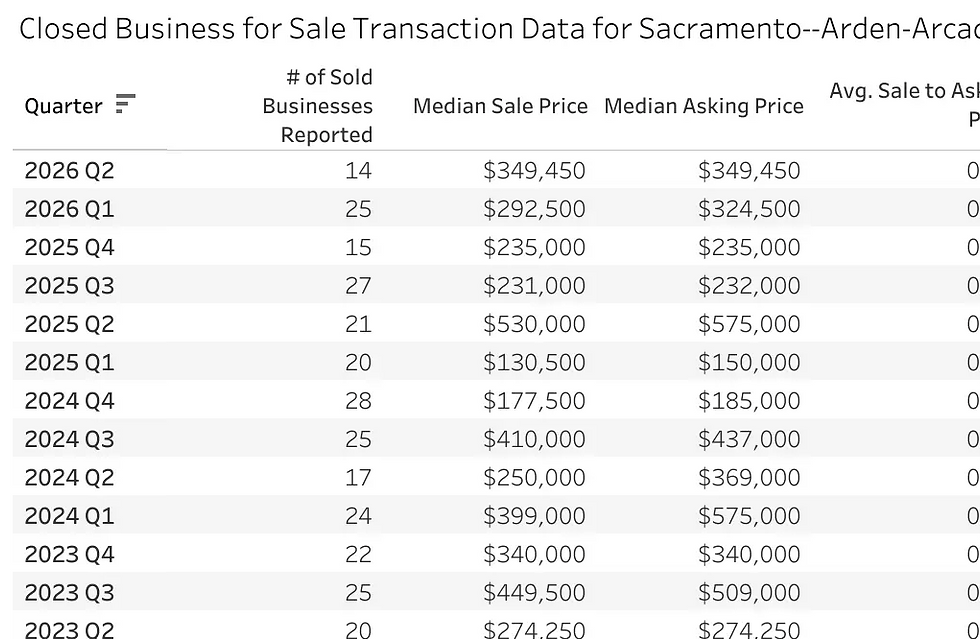
In 2025, there were 83 reported business sales in the Greater Sacramento area. The median sale price was $250,000, with median revenue of $446,226 and median cash flow of $125,000. Those sold for about 2.67x cash flow, which is close to the national number, and they took a median of 162 days to sell. The thing that stands out is the price. Our local median of $250,000 is well below the national median, and that's because our market has more small, main-street businesses and fewer large ones.
There's plenty for sale, too. Right now there are around 140 businesses listed in the area, with a median asking price of about $500,000. Keep in mind that asking prices and actual sale prices are very different things, and that gap is exactly why a realistic valuation matters. An owner who sets their price based on what they hope to get, instead of what the business actually earns, usually ends up sitting on the market longer and taking less in the end than they would have with the right price from the start.
One thing that hasn't changed is that a lot of our buyers come from the Bay Area, looking for a more affordable business to own and a different pace of life. I've written about this before. That outside demand is an advantage for owners here, and it's one more reason it pays to run a proper, confidential sale process instead of just listing the business and hoping the right buyer finds it.
What this means if you're selling a business in 2026
A few things to take away from all of this.
Deal with the pricing problem before you sell. If your costs have gone up and your prices haven't, it's hurting your profit, which means it's hurting your value. Fixing that is one of the most valuable things you can do in the year before a sale, and it's one of several ways to boost your business value. It also takes time to show up in your financials, so the earlier you start, the better.
Know what your business is worth before you need it. One number from the Q2 report stood out to me: only 14% of owners have had a professional valuation done, and 35% say they have no idea what their business is worth. The best outcomes almost always come from owners who understood the value of their business early and had time to grow it. That's why it makes sense to prepare well before you're ready to sell. A BOV tells you what your business is worth today and, just as important, shows you where to focus to grow that value before you sell.
The 2026 improvement is real, and buyers care about it. In almost every valuation I've done this year, the owner is expecting stronger numbers in 2026 than they had in 2025. Buyers care about where a business is going, not just where it's been, so a business that can show things turning back up is worth more than its 2025 numbers alone would suggest.
The market is active, and buyers are selective. Deal volume is down from last year, but 65% of business brokers expect it to pick back up in the second half of 2026, and that matches what I'm seeing. July is usually my slowest month, but this year I've had more valuation requests than in any July I can remember. In the same report, 46% of buyers described themselves as corporate professionals leaving their jobs to buy a business. A lot of them are using SBA loans, and they want to see clean books and a clear story before they move forward.
I tell every owner the same thing: know what your business is worth, and put your energy into building that value up while you still have the time.
Start with what your business is worth
If you want to know what your business is worth, that's the place to start. You can request your Assessment of Value and I'll prepare a Broker's Opinion of Value for your business. If you'd rather talk things through first, I'm always glad to have a confidential conversation at no cost. There's no pressure to sell on any particular timeline.


Comments