
Small Business Sale Prices, SBA Loans, and Costs in Q3 2026

The number of buyers reaching out through my website has gone up a lot this year. Many of them don't have a specific business in mind. They send over general criteria and ask what's available. The challenge is that there's a lack of good businesses on the market. A buyer I showed a business to earlier this month told me he's been looking for three and a half years.
The quality of the businesses isn't the only issue. A lot of owners want to price the business on what a new owner could do with it. They point to revenue a buyer could add or an expansion a buyer could make, but the buyer is the one who has to do that work.
When I value a business, I base it on what it's producing for the owner today.
As of October 1, a buyer's SBA lender can only count those earnings too.
The national data for the third quarter shows buyers paying more for the businesses that did sell. According to the BizBuySell Q3 2026 Insight Report, the median sale price of a small business sold in the third quarter was $350,000, up 17% from a year ago, even though 7% fewer businesses sold. BizBuySell says part of that increase came from a shift toward larger, higher-value businesses. In Greater Sacramento, BizBuySell's data shows a Q3 median of $435,000.
Below is what I'm seeing in my own work and what the latest data shows on sale prices, SBA loans, and costs. Most of the sale data comes from BizBuySell's report, and I've added new figures from the SBA and from NFIB's monthly survey of small business owners. There's also a section on what the Greater Sacramento numbers show.
Buyers are paying more for the best businesses
Two of the businesses I helped sell this year show the kind of business buyers are paying for. In March, I closed the sale of a specialty construction business in Northern California, and the winning offer was full price, all cash, from a private equity backed company that focuses on that type of construction. In July, the sale of a Sacramento dental laboratory I represented closed, and the buyer kept the lab's name, its core technical team, and its facility.
Private equity backed buyers like the one in March are showing up in smaller deals than they used to. In BizBuySell's Q3 broker survey, about a third of brokers said they're seeing more private equity firms and more search fund operators than a year ago.
Nationally, the larger businesses did best. According to BizBuySell, 22% of the businesses sold in Q3 went for more than $1 million, the highest share on record and more than double the share in 2017. The two groups sold on very different terms.
Businesses that sold for more than $1 million sold at an average of 3.73 times cash flow and 100.8% of their asking price.
Businesses that sold for under $1 million sold at an average of 2.30 times cash flow and 93.6% of their asking price.

Source: BizBuySell Q3 2026 Insight Report.
Size explains part of that difference. The rest comes from things the owner of a smaller business can work on before a sale. The first is having a manager or a team that can run the business day to day without the owner. The second is financials that are clean and match the tax returns. The third is revenue that comes from many customers instead of a few. When I value a business of any size, those are the factors that move the multiple up or down.
Who the buyer is sometimes changes what they're willing to pay. A competitor, or a private equity firm adding to the businesses it already owns, will often pay more than an individual buyer. An individual has to make a living from the business and usually finances the purchase. A competitor or a private equity firm can eliminate expenses it's already paying for, such as management and administrative costs, so the business is more profitable for that buyer.
Buyers are active, and they're selective
Earlier this year I wrote that buyers with Bay Area technology backgrounds are actively looking at Sacramento manufacturing and education businesses (Q1 2026 market snapshot). BizBuySell's national survey shows the same kind of buyer, with 51% of buyers describing themselves as corporate professionals.
According to BizBuySell, service businesses had their best quarter since Q2 2022, with 992 sold and a median sale price of $350,000, up 21% from a year ago. The median sale price of a manufacturing business rose 58% to $807,000. Retail and restaurant sales both fell.

Source: BizBuySell Q3 2026 Insight Report.
Buyers are careful about price. In BizBuySell's survey, nearly half of buyers said they believe the businesses on the market are overvalued. Asked about their biggest obstacle, 31% said finding a quality business. Gavin Raphael of Light & Raphael in Virginia described the market to BizBuySell this way.
"Lots of buyers and a lack of good profitable businesses for sale."
If you own a profitable business and your financials support its value, there are buyers looking for it. For manufacturing owners, I've written about what owners get wrong about manufacturing valuations.
The new SBA rules tie the price to past earnings
In roughly half of the deals I work on, SBA financing is part of the purchase. In BizBuySell's survey, 78% of buyers said they expect to use it, and the SBA approved 56,130 of its 7(a) loans in its 2026 fiscal year, the type of SBA loan used to purchase a business.
What changed on October 1
New SBA rules for business purchases took effect on October 1, 2026, and BizBuySell summarizes three of the changes:
An independent valuation is required on every SBA-financed change of ownership.
A quality of earnings report is required on acquisitions and expansions of $3 million or more.
The business's historical earnings have to cover its debt. Projections no longer count.
Before October 1, a lender could do its own valuation on smaller deals, where the amount financed was $250,000 or less, not counting real estate and equipment. That exception is gone, according to the accounting firm PBMares.
This is where the conversation about potential comes in. If a price is based on what the business could earn, the buyer's lender won't lend against it.
An example with the local numbers
Take a business with $161,000 in cash flow, the Greater Sacramento median for Q3 2026 in BizBuySell's data. At 2.62 times cash flow, the local average, the price is about $420,000. Now say the owner expects cash flow to reach $190,000 next year and prices the business on that instead, at about $498,000.
An SBA loan usually covers more than the price. Based on lender proposals I received last month for one of my listings, the buyer in this example also finances about $10,000 in closing costs and the SBA guarantee fee, puts 10% down, and borrows the rest over 10 years at 9.5%. The buyer also needs to bring their own working capital, in addition to the down payment. In both cases, the lender has to use the $161,000 the business actually earned, and the buyer pays themselves $80,000.
Priced on actual earnings | Priced on projected earnings | |
Price | $420,000 | $498,000 |
Down payment (10%) | $43,900 | $51,900 |
SBA loan | $395,000 | $466,700 |
Loan payments per year | $61,300 | $72,500 |
Left after the buyer's $80,000 pay | $81,000 | $81,000 |
Debt service coverage ratio (DSCR) | 1.32 | 1.12 |
Lenders call the last row the debt service coverage ratio, or DSCR. Under the new SBA rules it has to be at least 1.25 for a first-time acquisition. The first loan qualifies, and the buyer could pay themselves up to about $84,000 and still meet it. The second loan doesn't qualify unless the buyer takes about $70,000 or less in pay.
Interest rates and seller financing
Rates are also higher. The Federal Reserve raised its benchmark rate in September, and in BizBuySell's survey, 52% of brokers said interest rates affected their Q3 deals. In the example above, each one-point increase in the rate adds about $2,600 a year to the loan payments.
Seller financing can cover part of the difference between the price and what a lender will lend, and I've used it in several of my deals. BizBuySell says seller financing is increasingly helping buyers and sellers reach a deal. Under the new SBA rules, there are tighter limits on how a seller note can be used alongside an SBA loan, according to PBMares, so it has to be worked out with the buyer's lender early.
The seller note has to fit the business. In one deal I worked on, the payments on the proposed seller note would likely have been more than the business earned after the owner's pay. A note like that puts the buyer at risk of default and the seller at risk of not getting paid.
Costs are still rising, and more owners are raising prices
In my July post on the Q2 report, the theme was that in a lot of the businesses I value, owners haven't been raising the prices on their products and services fast enough to keep up with rising costs. The national data now shows more owners raising them. In NFIB's October 2026 survey, a net 33% of small business owners said they raised their average selling prices, more than double the survey's historical average of 14%. A net 37% plan to raise prices in the next three months, the highest since July 2022.
Even so, more owners are reporting lower profits than higher profits. In the same survey, the difference was 23 percentage points, the weakest result since March 2026. Of the owners with lower profits, 32% named weaker sales and 20% named higher material costs. A price increase that doesn't keep up with the increase in costs doesn't add to profit, and profit is what a buyer pays for.
Where costs are rising
On the cost side, nearly three-quarters of owners in BizBuySell's survey reported higher fuel and energy expenses, and 67% said inflation is not easing. Labor is the other big cost. In NFIB's survey, labor quality and availability was the top problem owners named for the fourth month in a row. In California, the minimum wage goes to $17.40 an hour on January 1, 2027, and the minimum salary for an exempt employee goes to $72,384 a year, according to the California Department of Industrial Relations.
What a price increase does to value
A price increase adds to the value of a business as well as its profit. Say a business sells at 2.5 times cash flow and the owner raises prices 10% without adding cost. Every $1,000 in sales becomes $1,100. That's $100 more in profit now, and at a 2.5 multiple it adds $250 to the value of the business.
The increase also has to show up in the financials before a buyer's lender will count it. A price increase made a few months before a sale shows up in only a few months of the trailing 12 months a lender reviews. A full year of higher prices shows up in all of it.
Clean books are part of getting financed
Buyers and their lenders compare the profit and loss statements to the tax returns. This year I started a valuation for a local field services company and had to put it on hold because the books and the tax returns didn't match. Here are some of the things I found.
A tax liability and customer refunds were recorded as income, so the revenue on the profit and loss statement was higher than the revenue on the tax return.
Net income on the profit and loss statement was different from the income on the tax return in all three years I reviewed. In the most recent year, the books showed a small profit and the return showed a loss.
The business had financed trucks and equipment, but the balance sheet showed no equipment, and none of the returns showed any interest expense.
Vehicle expenses on the tax return were almost double the amount in the books.
None of this means it's a bad business. Revenue had grown a lot over those three years.
I can't put a value on earnings I can't verify, and a buyer's lender won't lend against them.
I referred the owners to a bookkeeper to correct the records before we go any further.
If your books and your returns don't match, fix it before you go to market.
What the Greater Sacramento numbers show
By median sale price, the third quarter was the strongest of the year locally. According to BizBuySell's data for the Sacramento-Roseville area, 24 businesses sold in Q3 at a median sale price of $435,000, up from $292,500 in Q1 and $349,450 in Q2, and above the national median. The median business that sold had $161,000 in cash flow, and businesses sold at an average of 2.62 times cash flow and 96% of their asking price.

Source: BizBuySell Insight Report data tables, Sacramento--Arden-Arcade--Roseville, CA.
Keep in mind that 24 sales is a small number, so one or two larger deals can move the median a lot. A year ago, the Q3 median was $200,000. Over the first nine months of 2026, 63 sales were reported in the area, compared to 65 over the same months of 2025, so the number of businesses selling here has held about steady. Businesses are taking longer to sell, though. The median was 182 days on the market in Q3, compared to 146 days a year ago.
The listing numbers show the difference between asking prices and sale prices.

Source: BizBuySell Insight Report data tables, Sacramento--Arden-Arcade--Roseville, CA.
BizBuySell analyzed 276 businesses listed for sale in the area in Q3, with a median asking price of $389,000. Those listings were priced at an average of 3.13 times cash flow. The businesses that sold went for an average of 2.62 times, about 16% less. That difference has been there all year.
As I wrote in July, asking prices and sale prices are very different things. When a business is listed for more than its earnings can justify, it usually takes longer to sell or doesn't sell, so it stays in these listing numbers. Under the new SBA rules, it's also harder for a buyer to get a loan at that price. If you want to know what your business's earnings support, you can request an Assessment of Value.
Service businesses make up 47% of the listings in the area, according to BizBuySell's data, and nationally 77% of brokers named service as the sector drawing the most buyer interest.
If you're selling a business
Price the business on the earnings in your tax returns and financial statements.
Give a price increase a full year to show up in your financials.
Make the business less dependent on you and spread revenue across more customers. These are steps in creating an exit plan for the sale of your business.
Know what price your earnings will support at today's rates before you go to market.
Don't count on AI to raise the sale price of your business. According to BizBuySell, 68% of owners now use AI, up from 55% a year ago. Among owners planning to sell, half said it has little or no effect on what a buyer would pay, and only 15% of buyers said they prefer a business that already uses it. If AI helps you lower costs or grow sales, it adds value through your earnings, like any other improvement.
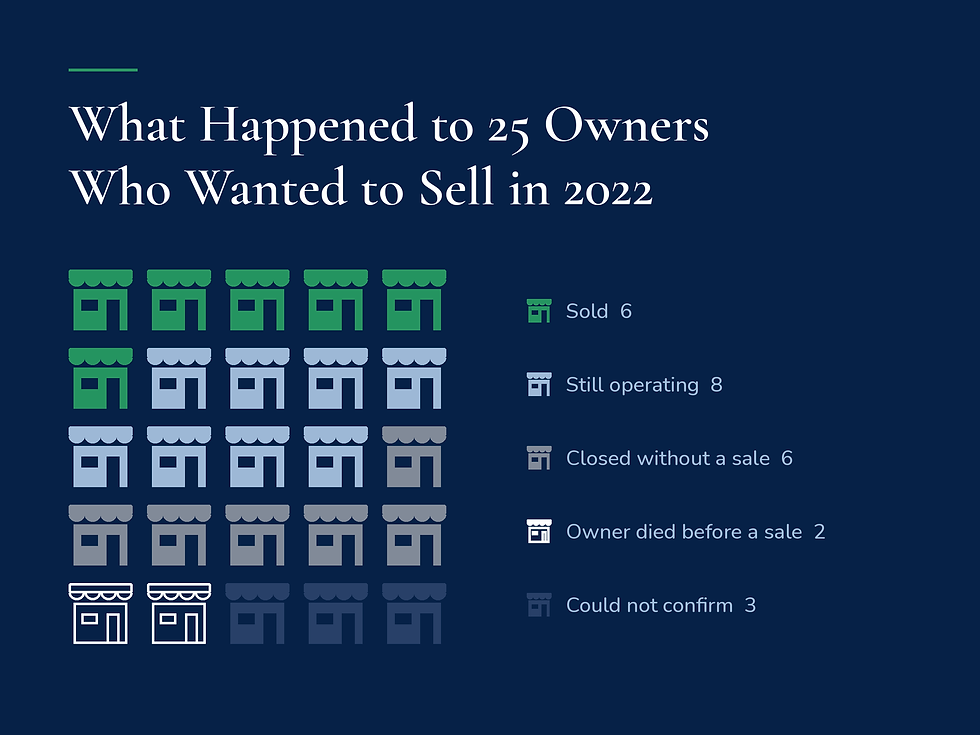
Start early. When I researched what happened to 25 owners who wanted to sell in 2022, 6 had sold, 6 had closed without a sale, 2 owners had died before a sale, and 8 were still operating. In a lot of those cases, the owner put off the decision until circumstances made it for them. On the other side, the owner of a service business came to me well before a sale. We're making improvements month over month to increase the value of the business, so that when it goes to market, sometime in 2028, it will be worth a lot more than it is today.
Start with what your business is worth
If you're thinking about selling in the next few years, start by finding out what your business is worth today and what would raise it. You can request your Assessment of Value and I'll prepare a Broker's Opinion of Value for your business, based on the earnings you've already reported. If you'd rather talk things through first, I'd be happy to have a confidential conversation.
Luke Middendorf is the founder of Sacramento Business Brokers and has helped business owners buy and sell companies throughout Greater Sacramento since 2022. He is a Certified Business Broker (CBB) through the California Association of Business Brokers (CABB) and a member of the International Business Brokers Association (IBBA). Before becoming a business broker, Luke owned and exited his own business. He has completed Broker's Opinions of Value for more than 130 businesses over the past four years. CA DRE 02196801.
This material is for informational purposes and is not legal, tax, or financial advice. Consult a licensed attorney, accountant, or financial professional about your specific situation.


Comments