.png)
What Happened to 25 Owners Who Wanted to Sell in 2022


In July 2022, my first year as a business broker, I started talking with owners in the Greater Sacramento area who were thinking about selling. By the end of that year, I'd had meaningful conversations with 25 of them. This year I went back through my notes and researched every one of those businesses to find out what happened.
Six sold. One of them sold at full market value, and I represented that owner. Eight are gone. Some closed, and others were shut down after the owner passed away. Eight are still operating, and several of them are still run by the owner who wanted to sell in 2022.
When I looked at why so few of these businesses sold, the same thing happened in most of them. The owner put off the decision until something else made it for them, whether that was a health problem, a partner dispute, or burnout. That's a big part of why many businesses don't sell.
What happened to the 25 businesses
Here is where the 25 businesses stand today:
Sold: 6
Closed without a sale: 6
Owner died before a sale: 2
Still operating: 8
Could not confirm: 3
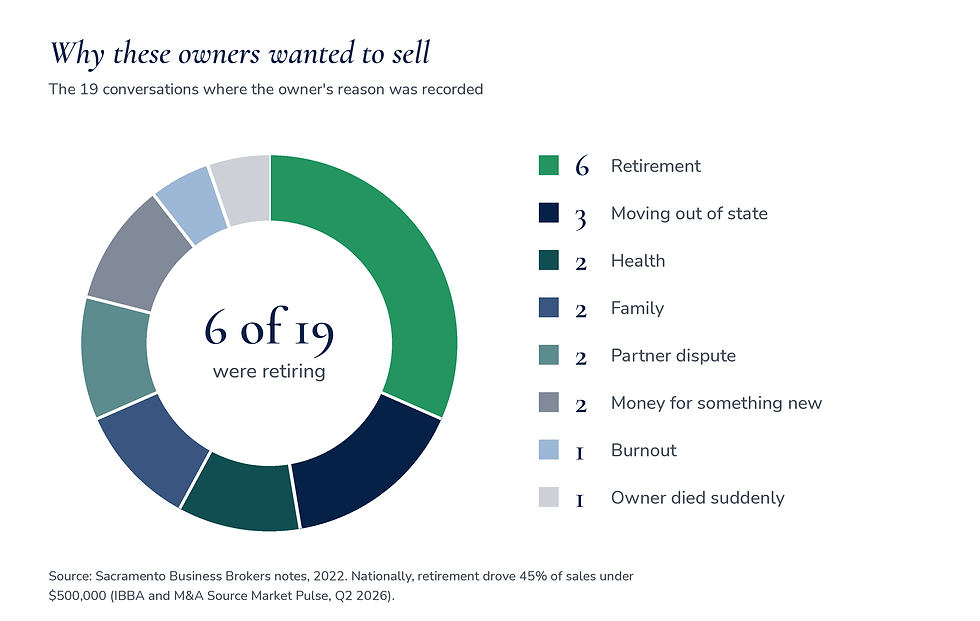
To find out, I went through my own notes and email, state business filings, auto repair license records, and Google and Yelp listings. I describe each business by industry only, so none of them can be identified.
Before I get to what happened to each business, here's why these owners wanted to sell in the first place.
Retirement was only one of the reasons
A lot of people assume a business goes up for sale because the owner is ready to retire. In my notes, retirement was the reason in 6 of the 19 conversations where I wrote one down.
The other reasons were a move out of state, a serious illness, the sudden death of an owner, a parent who needed care, partners who weren't getting along, burnout, and needing money for a new venture or a real estate purchase. One owner wanted to hand the business to a family member.
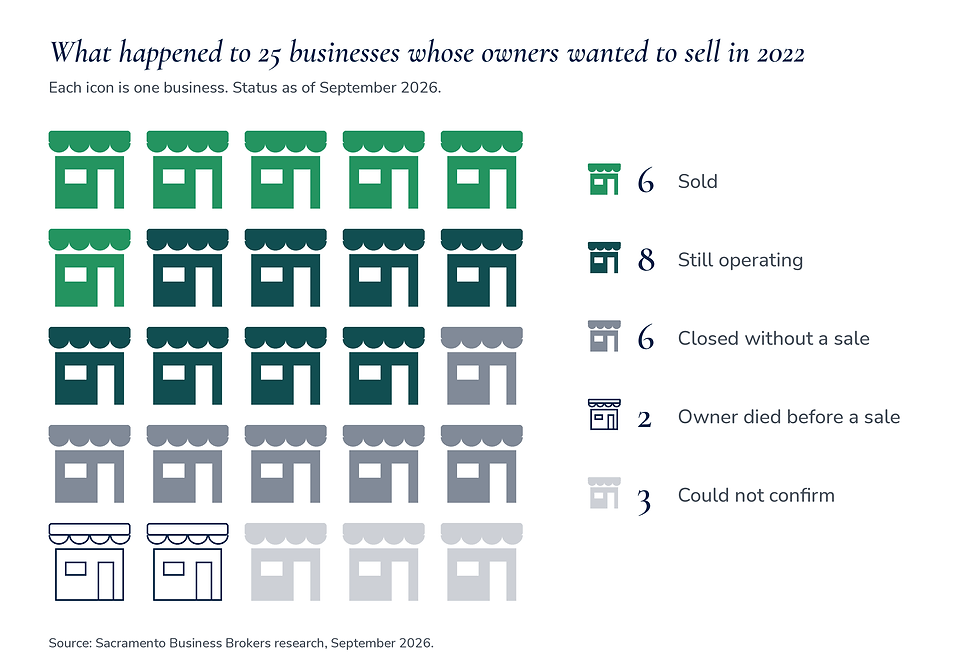
The national data for smaller businesses is similar. In the second quarter of 2026, the IBBA and M&A Source Market Pulse survey found retirement was the reason for 45% of sales under $500,000. Burnout, health, and new opportunities each accounted for another 14% to 17%.
This is important because an owner who sells for health or family reasons usually doesn't get to choose the timing. The reason for selling had a lot to do with how each of these businesses turned out, starting with the six that sold.
The six businesses that sold
Sold at or near market value
The first was a last-mile delivery contractor in the Greater Sacramento area. It was a very profitable business, and the owner wanted to move out of state, where his wife was already living. He had good managers in place and a strong reason to sell, and I was able to close the sale at full market value in a fairly short amount of time.
The second was an auto service franchise in Sacramento. The owner was ready to retire. The shop sold in late 2023, and from what I can tell the owner got close to market value.
Sold for less than the business was worth
A different owner had two auto service franchise locations. When we talked, both shops were at about break-even two years after he bought them, and he and his business partner were in a dispute. He sold both locations on his own in 2023, a few months apart. My understanding is he got less than the equipment was worth.
Sold, price unknown
A small-town pizza restaurant sold. The owner wanted to sell so he could buy commercial real estate, and the restaurant is still open under new owners.
The founder of an architecture firm was in his late 60s and wanted to retire. Another design firm acquired it, and the founder stayed on as principal architect. For a professional services firm, that's a good outcome, because the clients keep working with people they know.
I passed on a smoke shop because I don't represent that type of business. Another business broker sold it, I believe in 2023.
The six businesses that closed
Six other businesses closed without a sale:
A retail gift shop. The owners were retiring. A real estate broker they were friends with offered to sell it for them at a lower commission. He didn't find a buyer, and the store closed.
A pool service business with several employees. The owner retired and shut it down.
A small-town hardware store. The owners were retiring. It ended with a closing and liquidation sale.
A coffee shop with two locations. The owners were close to selling in 2022, then decided to hold on even though they were burned out. Both locations closed in 2025.
An off-road vehicle shop. The partners were in a dispute, and the business fell apart before we could list it.
A barbershop. The owner was burned out. My guess is he closed the shop and now rents a chair somewhere else.
Most of these businesses were still running when I talked with the owners. By the time they closed, the owners got whatever the inventory and equipment brought, and the value of the business itself was lost.
In the gift shop's case, the person trying to sell it wasn't a business broker. How to Choose the Right Business Broker to Sell Your Business covers the questions to ask before you hire someone.
If you're a few years from retirement, a Broker's Opinion of Value (BOV) will show you what your business is worth today and what a buyer will look at. Request your Assessment of Value.
When the owner dies first
Sadly, two of the businesses closed for a harder reason. The owner died before a sale.
In December 2022, I talked with the owner of a specialty construction contractor. It was a profitable business with a good reputation. He was dealing with a serious illness.
Over the next three years, I followed up several times. Each time, the answer was to check back in a few months. He passed away in late 2025, before we ever completed a valuation. The business is now closed.
I believe this business would have sold. I think he was afraid to start planning and afraid of what selling would mean for his future. That's a common feeling, and I'm not writing this to criticize him. But waiting meant the decision was never made.
A dry cleaner I talked with that same year was in a similar situation. The owner was only able to work about five hours a day because of health problems. I can't find the business operating today, and I believe the owner has since passed away.
One more call that year came from a family whose father had died suddenly. Nobody had his passwords, so they couldn't get into his accounting software or his bank accounts, and they were worried about making payroll. They wanted to know if the business could be sold quickly before it fell apart. I never received any financial data, and I think it's likely the business shut down.
Still operating four years later
The other eight businesses are still open, but that doesn't always mean things went the way the owner planned. Some of these owners decided to keep going. Others tried to sell and couldn't.
A professional practice owner wanted to move out of state, and we put the practice on the market in 2023. Several key employees left during the process. When the people doing the work leave, a buyer has much less to buy. The practice didn't sell, and the owner is still running it.
The owner of an auto repair shop wanted to sell in 2022 so she could care for a parent. The shop has gone on and off the market over the last couple of years and is now being marketed by the owner herself.
The one I'm happiest about is a cabinet manufacturer. The owner first called me in 2022, and I completed his first BOV that year. Since then, I've revised it several times as the business has grown, most recently in 2026. He now turns down work, and he plans to go to market in 2027. I expect the business to be worth far more than it was in 2022. For more on how manufacturing businesses are valued, see Manufacturing Business Valuation: What Owners Get Wrong.
The other five are an IT procurement company where the owner is preparing a family member to take over, a flooring store, a salon, a plumbing company, and an appliance repair company. From what I can see, all five are doing well.
What the national numbers show
Twenty-five businesses is a small group, so I also looked at what the national data shows. BizBuySell reported 9,586 small businesses sold in 2025, at a median sale price of $350,000. On average, those businesses sold for 94% of their asking price. For the businesses that got to a closing, it was a healthy market.
But those numbers only count the businesses that sold. They don't count the businesses that closed, the owners who waited too long, or the owners who decided to keep going. In my 2022 group, those outcomes were more common than a sale.
Planning is usually where it breaks down. In the same IBBA survey, between 60% and 90% of sellers had done less than a year of exit planning, or none at all.
Why many businesses don't sell
Looking back at these 25 businesses, a few things stand out.
Most owners don't get to choose when they sell. Fewer than half of the owners I recorded a reason for were retiring. Health, family, partners, and money set the timing for the rest.
Waiting doesn't make the decision easier. The contractor who deferred for three years never got to make it, and the coffee shop owners who held on in 2022 closed three years later.
A business needs to run without the owner. The delivery contractor sold quickly because good managers were already in place. The professional practice didn't sell after key employees left.
Partner disputes are hard on a sale. Two of these businesses had partners who weren't getting along. One sold for less than the equipment was worth, and the other fell apart.
Starting early works. The cabinet manufacturer I've been working with since 2022 will go to market with a stronger business and a plan. 5 Steps to Creating an Excellent Exit Plan walks through how to start.
If you're thinking about selling in the next few years, the first step is knowing what your business is worth and what a buyer will look at. Start with a Broker's Opinion of Value. All inquiries are handled in strict confidence.



Comments